Upskilling as Fiction
An example that keeps coming up. A company automates its warehouse management. The employees who had been counting inventory and sorting goods are retrained. They’re now supposed to do strategic logistics. Optimize supply chains. Interpret data analyses. Make decisions that were previously made by managers. It’s called upskilling.
But the matter-of-factness with which this happens is unsettling.
People who did physical work for years are now supposed to think strategically. Not because they want to or can. But because they need to be moved. Because AI is taking over their position. Sometimes that happens covertly, sometimes openly. I worked for many years as a strategic consultant and I know the responsibility that comes with having to make clear decisions. And I know it’s not everyone’s thing.
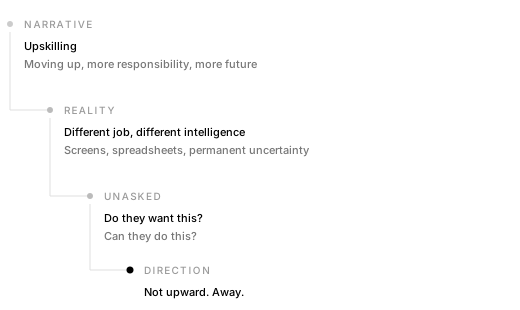
Upskilling sounds like moving up. More responsibility, more pay, more status. In practice it often means: you lose the job you were good at and get one you might not be able to do. The old job had clear procedures, physical work, visible results. At the end of the day you could see what you’d done. The new job has screens, spreadsheets, meetings and the permanent uncertainty of whether you understand what you’re doing. I always had this uncertainty and I used it as a traffic light: go, stop or wait for more data.
What I see is that nobody asks whether these people really want this. And nobody really checks whether they can. Or whether they can want it. Or want being able to. If I want to learn something new, I also have to understand the responsibility that comes with it.
These two questions are rarely asked.
The first: Want. There are people who chose physical work. Not for lack of alternatives. But because they’re good at it and because they like it. Because it’s satisfying to see an organized warehouse at the end of the day. Because working with your hands produces a kind of pride and satisfaction that doesn’t appear in any job description. These people are now put in front of a screen and expected to treat it as a challenge.
The second: Can. Strategic thinking is not a skill you learn in a three-day seminar. It’s a way of thinking that develops over years. Some people have it. Others don’t. Not because one group is smarter than the other, but because there are different kinds of intelligence. Someone who carries the entire warehouse in their head, knows every position, senses shortages before they show up in the numbers, has an ability no course can teach. But that ability no longer counts. What counts are entirely different abilities. Often subtle, not tangible, and when they can reach for something tangible, it’s a gut feeling. Which you also have to be able to grasp. A gut feeling develops over many years.
As so often I only hear success stories. The employees were empowered, the transformation succeeded, but the number of those who gave up along the way stays in the dark. How many, after retraining, do work they don’t understand, work that frustrates and burns them out, because it was sold as fulfilling and as an upgrade, which doesn’t prove to be true.
In consulting they call this redeployment. It means: we no longer need you for what we hired you for. But we’re not firing you, we’re giving you something else. And selling it as something better. That sounds humane at first, but in practice I’ve often seen a slow farewell. Because many employees realize over time that they can’t keep up in the new job and lose confidence in themselves and in the company. They function on the position for a while, but don’t fill it with life.
The honest version would have been: We automated jobs and while some of the affected people could adapt, others couldn’t. And for them there’s no plan that actually works. Upskilling worked for some, and for others it was an initially appealing form of challenge that became overwhelm.
But honesty is not a success story that fits in PowerPoint presentations. Instead the word upskilling suggests a direction: upward. You can do more, you’re worth more and you have a future here. My experience is that this really works only for the very few.
How these texts are written is explained here.