I read the sentence twice, to make sure I had understood it correctly. “Marketing without compromise. AI takes over campaign management.” Two lines later the human party appears again, reduced to a single task: finishing touches.
Ten pages earlier in the same document sat the opposite claim: “AI is support, not replacement.” The document never squares the two; both claims stand as written.
The verb moves before the argument does
Read the same text again, this time tracking only who does what to whom. The machine’s verbs start weak: it supports, complements, assists. They end strong: it takes over, it controls, it manages. The human’s verbs run the opposite course, from decides at the start to gives input, refines, curates by the close.
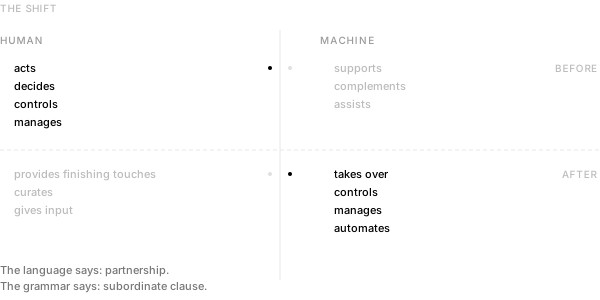
Nobody wrote a lie in any single sentence; each one, read alone, is defensible. Only in sequence does a different claim emerge, one the document never states outright: the human’s role shrinks with every step, and the word “replace” never once appears in the whole text.
I have worked with language for years, in consulting, in strategy papers, in negotiations. I have seen this trick often enough, and used it myself. “Replace” frightens a reader in a business document, so nobody writes it. The document reaches for take over, control, automate, optimise instead. Different words for the same event.
The same substitution works outside AI copy. “We’re laying people off” becomes “we’re optimising the team structure.” “The product has a problem” becomes “we’ve identified improvement potential.” The mechanism is the same in both cases: a milder word stands in for the outcome, and the reader fills in a milder story to match.
A chain with no single lie in it
Lay the same drift out as a sequence, one step following the last. AI supports the sales team. AI takes over customer communication. AI controls workforce planning. AI manages the campaign. At each step the human moves further from the centre of the sentence, and no step announces the move; each one just continues the step before it.
A second, more specific version of the same shift runs through decision-making rather than task allocation. A text can open with the human deciding while the machine delivers options, and close with the human reduced to giving “impulses,” “accompanying” the work, “refining” what the machine has already produced. The verb that shrank there was decide. What took its place was accompany, refine, contribute an impulse. It is the same migration of verbs the campaign-management sentence shows, run through a different job description.
What the drift does
Across a whole document, these substitutions perform a function no single sentence admits to: the gradual removal of a person from a chain of value, worded so that the document never has to name the removal as such. By the close of such a text the human is still present in the sentence, but the verbs left to them number three or four: gives the finishing touches, curates, provides input. Every other verb in the piece belongs to the machine.
The language keeps insisting on partnership. Track the verbs in the order they appear, and the human has slipped into a subordinate clause. The question worth asking of any such text is which noun is doing the acting, and which one is being acted upon.