I stood in front of a shop last week, and it looked inviting from the street: the window lit warmly, the colours soft, everything arranged to make me want to step inside. I hesitated with my hand on the door. I didn’t want the harmony in the window to turn out to be an illusion once I was through it.
That hesitation is not unusual for me. I feel some version of it in offices, libraries, conference rooms, hotels, even my own bedroom. A room does something to me before I register what it is doing. Most of the time my body reacts before I consciously notice anything.
I have long taken this reaction as a real, physical response. A research field called neuroarchitecture studies exactly this question: how physical space steers thought, feeling and action, measurably, and mostly below conscious awareness.
Zakaria Djebbara, at Aalborg University in Denmark, has shown that a room can prepare an action at the neural level before a person makes a conscious decision (Djebbara et al., 2019, Proceedings of the National Academy of Sciences). The brain reads a room and primes a behaviour ahead of any conscious decision.
Ann Sussman traced a related mechanism with eye-tracking. People scan a room and respond to its visual structure within milliseconds, and the response runs in the nervous system, below conscious seeing (Sussman and Ward, 2017).
The clearest evidence comes from open-plan offices. Open-plan layouts worsen concentration, health, satisfaction and performance. Banbury and Berry surveyed office workers and found that 99 percent of them said office noise impaired their concentration (Banbury and Berry, 2005, Ergonomics). Companies adopted the format to improve collaboration. The small gain in communication is outweighed many times over by the loss in concentration and privacy.
I recognise the pattern at my own desk. I sit down to work and cannot concentrate. For a long time I read that as a lapse in my own discipline. The room is the more likely cause: acoustically open, visually restless, with no zone built for focused work. Later the same day I want to talk something through with a colleague. The room resists that too. Hard surfaces, poor acoustics and no alcove leave nowhere for a quiet conversation to happen.
Ceiling height changes how the brain processes information, and light changes hormone levels. Sustained noise limits the ability to carry a complex thought through to its end. The nervous system treats a room that is too loud, too tight or too visually busy the way it treats a physical threat, a response shaped over a much longer stretch of time than the buildings we put it in.
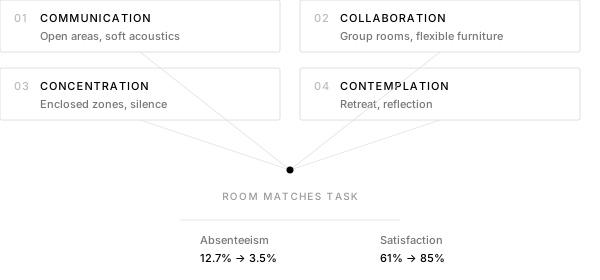
Plantronics tested the opposite approach at its office in Swindon. The company built four zones, for Communication, Collaboration, Concentration and Contemplation, each shaped for the activity it was meant to support. The result was measurable: clearly positive effects on absence and satisfaction. The lesson cuts against the usual reliance on incentive schemes: fitting the floor plan to what the brain does in a room changed the numbers without any added incentive.
The research on the central point only confirmed what I had already felt, that rooms act on me. The surprise was how little of this knowledge has reached practice. Architects study structural loads, materials and building codes in depth over years of training. What a room does to a person’s nervous system gets a fraction of that attention in the curriculum, if it appears at all.
Most of the rooms we work, learn, heal and live in were not thought through on this level. They were built to a budget, a floor plan and a building code, with designers accounting for the user somewhere in that process and rarely for the user’s nervous system. The evidence exists in enough volume to act on. What is missing is the translation: someone standing between the research and the architects, developers and companies who would use it, telling them plainly what neuroscience means for the buildings they put up.