For almost a decade I worked in an office in Munich. It faced south and had a very large window, so the light was good. Through that window I looked at a car park and the building across from it, a concrete block with windows. Behind that building, just above its roofline, stood a group of trees. I could see only the treetops, moving in the wind.
Those trees told me every day that nature existed and that I could reach it after work and at the weekend, not before. I caught myself staring at them, the same view each day, the same gap between where I sat and where I wanted to be. The gap never closed. On the top floor of the building opposite there was a gym, which gave me something to watch in the evenings when the lights were on, and over the years I got used to seeing the same people in it. The seasons and the weather changed just enough to keep me believing in the place.
What I carried home each evening was a constant, low-grade tension. I worked in other rooms over those years too, and some of them felt different; I could work in them and leave without taking the tension with me. The cause was in the room itself. Whoever designed it decided that, and never pictured the person who would sit there.
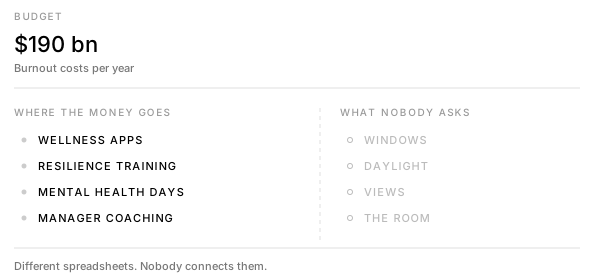
Every year, workplace stress adds between 125 and 190 billion dollars to American healthcare costs (Goh et al., 2016). That figure counts healthcare alone; lost productivity, turnover and absence sit on top of it. The response is an industry: wellness apps, resilience training, executive coaching, mental health days. All of it treats the person, and the building that shapes the person stays out of the account.
Documented for Decades
The effect of the room is well documented, and has been for decades.
Ihab Elzeyadi at the University of Oregon studied employees in an office building in 2011 (Elzeyadi, 2011). Those with a view of trees and landscape took about 11 fewer hours of sick leave a year than those with no view, 57 hours against 68. The light and the view together tracked with how often people called in sick, not the workload or the manager.
Windows change sleep. In 2014 Boubekri compared office workers with and without windows, and the ones with windows slept on average 46 minutes longer per night (Boubekri et al., 2014, Journal of Clinical Sleep Medicine). The study was small, but the difference in sleep, mood and focus was clear.
Nature calms the body directly. Back in 1991 Roger Ulrich showed that blood pressure and muscle tension settle faster after a stressful moment when you look at nature instead of a street. Even a plant on the desk measurably lowers the stress response (Lohr et al., 1996, Journal of Environmental Horticulture).
Then there is noise. Noise is the most common complaint in open-plan offices, which Kim and de Dear counted across more than 40,000 respondents in 2013 (Journal of Environmental Psychology). Nature sounds turn it around: Alvarsson found the body recovered 9 to 37 percent faster than under noise (Alvarsson et al., 2010).
Air matters too. In 2012 Satish measured how decision-making drops with poor ventilation, almost to a standstill at high CO2 (Satish et al., 2012, Environmental Health Perspectives). The finding is contested, but the direction is plausible. And whoever has nowhere to retreat to burns out faster (Laurence et al., 2013).
None of this is new. It sat in the literature while my Munich office was designed, and while a hundred offices like it were being designed alongside it.
Why Nobody Can See This
Elzeyadi, Boubekri and Ulrich published all of this years ago. The people who choose where a company builds never read it.
HR thinks in programmes. It can offer a course or an app, and it measures its work by what it runs, so the room never enters the account. Facility management arrives too late. It can add plants and acoustic panels once the building stands, but it cannot move a window or turn a floor to face a different direction.
A company makes the decision that matters before the architect is ever hired, first when it decides to build at all, then again when it chooses a site. Orientation, the view, how far the trees are: these are settled at that stage and are almost impossible to repair afterwards.
The two cases part ways here. In a new building, facing the good direction costs no more than facing the bad one, so getting it right is nearly free. Correcting an existing building is expensive and often impossible, because a window and a floor’s orientation are already fixed.
Loss and Recovery
Take a plausible mid-size case, with round numbers chosen only to show the shape of the thing. Say each employee generates 572,000 dollars a year and loses about 17,000 dollars to stress-related absence and distraction. That would be 3% of productive capacity gone. A 200-person office losing 3% would burn 3.4 million dollars a year.
Against that, one measure. Elzeyadi put the gap at about 11 recovered hours of sick leave per employee a year. On my own arithmetic, those hours across 200 people at this example’s rates come to roughly 605,000 dollars a year, about 18 percent of the 3.4 million lost.
The Gap
I think about the trees above the roofline in Munich. Someone chose the site, the orientation and where the window went: a car park and a concrete block for the view, the trees kept just above the roof and out of reach. Nobody in that decision asked what the person at the desk would see for the next decade.