Recently I tried to switch music-streaming services. The technical part took ten minutes: cancel one subscription, start another, sign in. In practice, I am still with the old service.
The old service simply knows me better than the new one ever could. Over years of listening it learned what I play on the way to work in the morning, when I want something to push me along, and what I put on in the evening when I want to come down. Music does not really serve that mood function for me, or so I would have said before I noticed how accurately the service tracked it anyway. It built playlists around a pattern I had never named myself, and the playlists kept surprising me with how close they came. It keeps finding new tracks I had not heard before and now like.
None of that moved with me when I tried the new service. I could set up an account, add my favourite artists, rate a few songs. I could not arrive where I already was on the old one. The profile the old service holds is not mine to export. The service built this profile about me over years, and it exists only there.
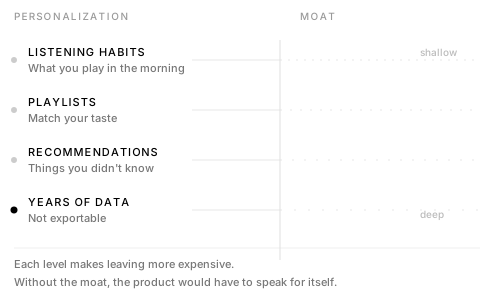
Call this a moat, the term startups use for a barrier competitors cannot easily cross. Startups discuss the strategy openly. Personalisation has created switching barriers for as long as services have collected data about their users. Every round of it collects more data, understands the customer better, delivers more precise results and digs the moat a little deeper. Companies build this deliberately: the switching barrier is what the personalisation is for.
The same thing happens with software that has nothing to do with music. Spend ten years in one program and you learn its templates, its workflows, every shortcut. An alternative arrives that would probably suit you better. You stay with the old program anyway, because the years of learned habits do not transfer with you, and using the better tool would mean beginning again from nothing.
The concept has a name in economics: switching costs. The costs are not always in money. Often they show up as time, patience and the plain reluctance to relearn something you already know how to do. Switching costs are a competitive advantage for the company that builds them, and a loss of choice for the customer who pays them, delivered through the back door. The choice to leave stays on paper. But every day inside the service makes leaving cost more than it did the day before.
A visible barrier provokes resistance. Personalisation raises the cost of leaving invisibly. It adapts to what you like and grows more pleasant with time, and every day inside adds to how hard leaving would be.
If personalisation were only the comfort it is sold as, the export button would already exist. A file with my listening history, my stated preferences, the weights of whatever algorithm the service has trained on me. Nobody spends a hundred million dollars on personalisation out of kindness. An export button would let the moat run dry, and the product would have to stand on what it does today, without the years behind it.
How much of what companies call customer retention is the product being good, and how much of it is the cost of leaving having quietly become too high to pay. I never cancelled the old subscription.