I was at a trade show in Cologne, walking past a stand with two hundred wristbands. All shiny, all identical. A man stood in front of the display, broad-shouldered, athletic. The seller had him do a balance test. Stand on one leg. Extend your arms. He raised his arm, held his upper body straight, and I pushed against it. He held.
I’m amazed, he said. I can feel it. Incredible. This really keeps me more stable. Next to us, people applauded. His girlfriend bought three bands, 39.90 euros each. I saw the bills go into the register.
I have an e-commerce background, and on an imaginary napkin in my head, I started the calculation the way you do when you understand scaling. One seller moves ten bands a day. A year has 250 working days. The stand had a hundred people in sales. That is a quarter million bands a year. My margin, roughly ten euros per unit. Two and a half million euros a year. Profit.
The number felt enormous, and in this fit of total delusion, I was calculating only half the truth.
The other half
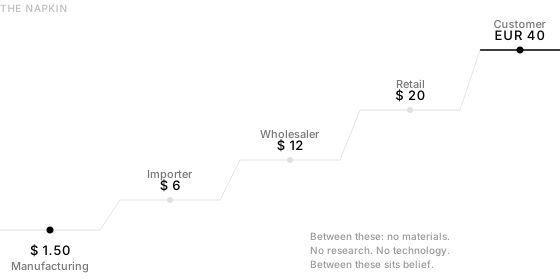
Manufacturing a band, with packaging, costs 1.50 US dollars. Silicone, a hologram, a package. That is all there is to it. The manufacturer sells to importers for six dollars. They sell to wholesalers for twelve. They sell to retail for twenty. The end customer pays forty.
Between 1.50 dollars and 40 euros, there are no material costs and no research costs. What fills that gap is almost entirely the promise that the band does something.
What my napkin math left out was everything that happens after the sale. Returns. Complaints. Legal questions once someone asks what the seller actually claims the band does. Media coverage, if a journalist picks it up. Customers who want their money back weeks later, once the balance test wears off as a memory and the band is just silicone on a wrist. The original margin erodes fast once any of that starts.
In the moment itself, none of that is visible. The seller, the customer, the applause, the ringing register, all of it crowds out the one question that actually matters: does the band do anything. Calculation and doubt do not logically exclude each other. In practice, the calculation pushed the doubt aside, and I was doing the calculating.
Why forty euros
Forty euros was a deliberate choice. A three-euro wristband would convince no one. Forty euros signals that something real must be behind it, while staying low enough for an impulse purchase at a trade show, cash in hand, girlfriend watching.
The mechanism runs further than the sale. Someone who pays a high price for something is more likely to believe it works, and more likely to defend that belief to a friend, a partner, a stranger who asks about the band on their wrist. Each defence of the purchase reinforces the belief that produced it. The band works because the buyer needs it to work.
The mechanism has a name: cognitive dissonance. When an action and a belief do not match, the mind adjusts the belief. The action, the forty euros already spent, stays fixed.
On the napkin in my head that day, the numbers were the ones I cared about at the time: units sold, margin per unit, sellers, working days. What was missing was what happens once customers stop believing and stop buying. That second half of the calculation came to me later, in a different context.