“I’m stuck. I don’t know how to move forward.” I hear this sentence often, in different forms. Sometimes the job has felt wrong for years. Sometimes a redundancy forced the question. Increasingly often, everything works on paper and the person still cannot say why it no longer feels worth doing. What these situations share is a conviction that something has to change, paired with no idea what that something is.
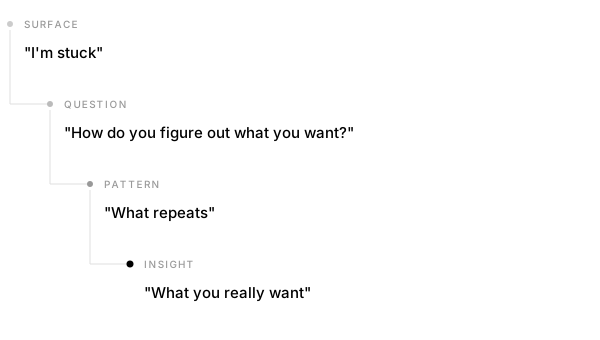
The usual first move is coaching: a strengths assessment, a personality test or a systemic exercise. These sessions tend to end with a plan, a checklist or a tool to apply. In my experience that often does not work, because a prior question gets skipped before anyone reaches for the tool box.
Take the word “freedom”. People use it as if it named one thing. It does not. It is a door, and behind it sits any number of different rooms: financial independence, control over one’s own schedule, the absence of a particular manager and authority over the content of one’s own work. Each of these has different practical consequences, and most conversations take the word at face value instead of asking what stands behind it.
“Success” works the same way. Some people mean a standard they set for themselves. Others mean a stereotype absorbed early, one whose pressure they never quite stopped feeling, without noticing that the goal was never their own. And “doing something meaningful” often hides a need that is entirely personal and does not require a moral justification at all, even though people reach for one anyway.
This can sound like a philosophical exercise. The answer decides what someone actually does next.
What actually predicts the future
I went through this process myself, with a psychologist who has worked with biography for decades. What it gave me was the recognition that the answer already existed. I had simply never observed my own thinking carefully enough, and I had used the wrong words for what I found.
The principle that followed from this: the past predicts the future more reliably than any wish or mental image of a future self. What has satisfied someone before tends to satisfy them again, and frustrations repeat the same way. Looking backward is more reliable than looking forward, because a biography does not lie the way a stated preference can.
In practice this means working with stories. Someone recounts six key moments from their life, and across them, in conversation, a pattern becomes visible that neither of us set out to find. What a person chooses to tell matters, and what they leave out can matter as much or more. The pattern outweighs any self-assessment, because it is based on documented behaviour.
I have since adapted this into a framework of seven dimensions, from capability and personal history through to the concrete direction all of it points to, each one building on the answers to the ones before it.
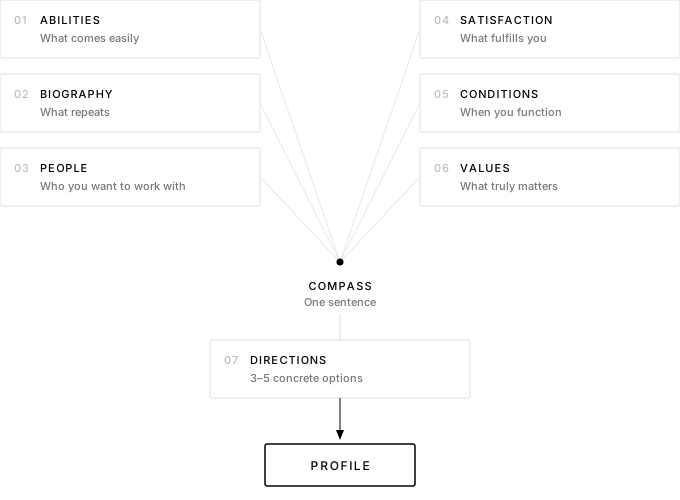
What comes out of this is a profile of capabilities, patterns, values and conditions, solid enough to test real decisions against, because the person recognises, on their own terms, what fits and what does not. “Fits” sounds casual. Feelings often do not express themselves more precisely than that, even when the direction they point to is clear.
Knowing yourself is one of the hardest kinds of knowledge to reach, because the person doing the observing and the person being observed are the same. You cannot step outside yourself to look. What helps is someone who listens and reflects back what they hear, translating what a person already knows but has never managed to put into words, into language precise enough to act on.
Career clarity comes from the right questions, asked in a way specific enough to the person in front of you.