What the Room Does to You
From outside it looked appealing. The window display nicely lit, warm colours, I wanted to go in. I hesitated when opening the door because I didn’t want the harmonious image from the window to turn out to be an illusion. Because when I enter a shop, I usually sense within milliseconds whether I’m welcome or not.
In offices, libraries, conference rooms, hotels and even in my bedroom, it’s the same. Every room does something to me, it supports me or it holds me back. Mostly I don’t notice it consciously, but my body still reacts.
I had long suspected that this isn’t only imagination, and that rooms actually steer how we think, feel and act. Not in a figurative sense, but very concretely and measurably. And the suspicion holds. There’s a whole research field for it, and it’s called neuroarchitecture.
Zakaria Djebbara has shown at Aalborg University in Denmark that rooms prepare actions on a neural level before we make a conscious decision (Djebbara et al., 2019, Proceedings of the National Academy of Sciences). The brain senses the room and activates patterns of action. So you don’t decide on your own how you behave in a room, the room decides with you. Ann Sussman has used eye-tracking to show that we scan rooms unconsciously and react to visual structures within milliseconds (Sussman & Ward, 2017). It’s not about what we consciously see, but about what happens unconsciously inside us, in the nervous system.
And then there’s the research on open-plan offices. Hundreds of studies, summarised in systematic reviews, and the result is fairly consistent: open-plan offices worsen concentration, health, satisfaction and performance. In a study by Banbury and Berry, 99 percent of those surveyed said that office noise impaired their concentration (Banbury & Berry, 2005, Ergonomics). The ironic part is that open-plan offices are actually built to encourage collaboration. But the research shows that the few positive effects on communication are completely eaten up by the negative effects on concentration and privacy.
I want to work and can’t concentrate, not because I lack discipline, but because the room is acoustically open, visually restless and offers no zone for focused work. I want to talk with people, but the atmosphere isn’t made for communication, because hard surfaces, poor acoustics and missing niches make confidential conversations impossible.
This isn’t imagination, this is physiology. Ceiling height affects cognitive processing, light affects hormone levels, and noise affects the ability to think complex thoughts through. The brain doesn’t distinguish between the threat of an aggressive person and the threat of a room that is too loud, too cramped or too restless.
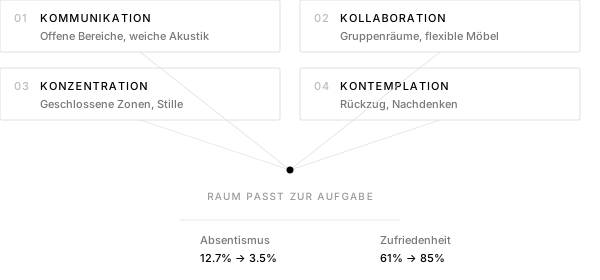
Plantronics introduced four zones in their office in Swindon: Communication, Collaboration, Concentration and Contemplation. Each zone is designed for a particular activity, and the result was remarkable, with clearly positive effects on absence and satisfaction. So it doesn’t always need expensive motivational programs, it needs neurophysiologically thought-through room design.
What surprised me about the research isn’t that rooms have an effect, that I’ve always sensed. What surprised me is how little this knowledge gets applied. Architects learn statics, materials and building law, but what a room does to a person’s nervous system seems strongly underrepresented in the curricula.
It has hardened my suspicion that most of the rooms in which we work, learn, heal and live aren’t consistently thought through. They are built for budgets, for floor plans, for building codes. The person who uses the room appears in the planning, but their nervous system doesn’t. The research and the evidence are there. What’s missing is the translation into practice, and someone who explains to architects, clients and companies what neuroscience means for the performance of their buildings.
How these texts are written is explained here.