The Napkin Calculation
Trade show in Cologne. Behind me a stand with two hundred wristbands. All shiny, all identical. In front of me a man, broad-shouldered, athletic. He grins as I give him the instructions. Stand on one leg. Extend your arms. He raises his arm, holds his upper body straight, I push. He’s amazed. I can feel it, he says. Incredible. This really keeps me more stable.
Next to us, people applaud. His girlfriend buys three bands. 39.90 euros each. I see the bills in the register.
In that moment, I’m calculating. On an imaginary napkin in my head, the way you do when you come from e-commerce and understand scaling.
One seller moves ten bands a day. A year has 250 working days. A hundred people in sales. That’s a quarter million bands. My margin: roughly ten euros per unit. That’s three and a half million euros. Per year. Profit.
In this fit of total delusion, I was calculating only half the truth. Or rather: a tiny fraction of it.
Because between the production side and the sales side, there’s a gap, and that gap is called reality.
The numbers on the production side: Manufacturing with packaging, 1.50 US dollars. Silicone, a hologram, a package. That’s all there is to it. The trade structure looked like this: The manufacturer sells to importers for six dollars. They sell to wholesalers for twelve. They sell to retail for twenty. The end customer pays forty.
Between 1.50 dollars and 40 euros, there are no material costs. No research. No elaborate technology. What sits there is mostly a promise. The margin consists almost entirely of the belief that the thing does something.
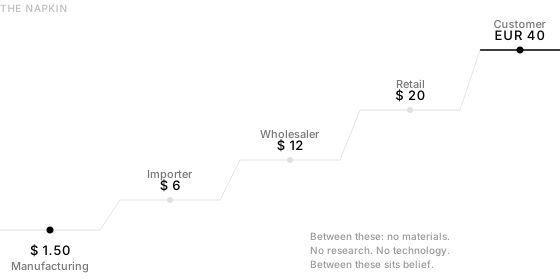
That’s what I hadn’t factored into my mental math at the trade show. I only saw the ten euro margin I had internalized as a law of nature. What I didn’t see: returns. Retailer complaints. Legal questions. Media coverage. Customers who realize after a few weeks that the wristband does nothing, and want their money back. The ten euro margin was pulverized pretty quickly.
But on that day at the trade show, none of that was in the air. There was only euphoria. The athlete who’s amazed. The girlfriend who buys. The people around them who watch. The register ringing.
It’s remarkable how quickly the math replaces the questions. I stood there and didn’t think: Does this actually work? I thought: How many of these can I sell? The two don’t rule each other out. But in practice, the calculation crowds out the doubts. When the numbers work, everything feels right.
I later learned a lot about pricing. About the connection between price and perceived value. A wristband for three euros, nobody would take seriously. Forty euros is enough to create the impression that there’s something behind it. Not too expensive for an impulse buy. Expensive enough to suggest value.
The price wasn’t an accident. The price was part of the effect. If you pay forty euros for a silicone band, you have to believe it works. Otherwise you’d be someone who paid forty euros for a silicone band. Nobody wants to be that person. So it works. Because it has to.
That’s not a conspiracy. That’s psychology. The technical term is cognitive dissonance. When an action and a belief don’t match, the mind adjusts the belief. Not the action.
On my napkin there were numbers. Revenue, margin, volume. What wasn’t on the napkin: the question of what happens when customers stop believing.
I’d done the math. But I’d only done half the math. The other half came later. And that one couldn’t be solved on a napkin.
How these texts are written is explained here.