Fighting Content Fatigue with More Content
I finally managed to permanently delete Instagram and Facebook from my iPhone. I was genuinely fed up and I see it as a trend with others too. OK, it’s not really a trend, but content fatigue is becoming visible. People aren’t just tired of content on the usual social media channels. And even though they keep scrolling, they’re not absorbing anything anymore. What I find truly remarkable is the response of most content producers: even more content. Just produced faster, because AI. It is in all seriousness the strategy of a company I know to counter the declining perception of their content with even more content. That’s like treating obesity with even more food, and exclusively with processed food at that. The image alone makes me feel sick. I still have YouTube and it’s psychologically impossible to avoid scrolling through a few reels. I feel like a victim. And it annoys me.
The problem isn’t just that the content is wrong or bad. We’re being force-fed absolutely indigestible portions of it. My only personal success is that I’ve stopped cleaning my plate.
There’s simply too much content. Every company produces it in bulk thanks to AI. Completely unreflected, it gets dumped across content channels by the hour. I don’t know by what factor the sheer volume has multiplied in recent years, but people’s capacity to absorb it has been pushed to the maximum. A container that’s full simply doesn’t take any more. A brain that’s been numbed just scrolls through apathetically.
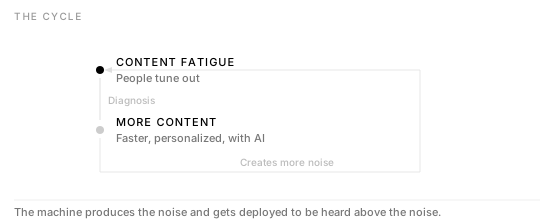
What AI does in content production is not raise quality but lower the threshold. What used to require a copywriter and half a day of work now takes a prompt and three minutes. The more it’s stuffed with violence, sex, fails and drama, the better. Well, not better, but at least somehow more present in people’s perception. But statistics say that’s over too, because a pain threshold has clearly been crossed. Nothing against cat videos, but it doesn’t get better with more cat videos.
AI can be helpful in sending the right message at the right time to the right person, but in practice that means twenty companies simultaneously send the supposedly right message to the same person. To a person who may have already switched off long ago.
Content fatigue isn’t solved with better content and certainly not with more, but with less. With silence and the eloquent restraint of not saying something when you have nothing to say. That’s obviously not in any marketing book, because restraint isn’t a business model. But should I ever write another book about AI, this will definitely be a topic.
In my life I’ve read texts that changed me as a person and moved me forward. Not because there were so many texts, but because someone genuinely had something to say. Not because an editorial calendar demanded it. You can tell the difference immediately, sometimes just from the title.
AI can produce texts, but it doesn’t yet know when it’s better to say nothing.
How these texts are written is explained here.