The Building That Works Against You
I spent almost a decade in a Munich office. It faced south and had a very large window. So there was plenty of light coming in, which should have been enough, but what I saw through that window was a parking lot and a dominant concrete building across the street. Behind it, just visible above the roofline of the opposite building, was a group of trees, and I could really only see the tops, how they moved in the wind. That was my daily reminder that nature existed, but it was only reachable for me after work and on weekends.
I kept catching myself staring dreamily at those trees. Every day the same view and every day the same gap between where I was sitting and where I wanted to be. The seasons and the weather offered just enough variety that I still believed in this place. But the gap never closed.
It sounds like a small thing, but it wasn’t. It was a constant, low-grade tension that never let up. The trees were right there, but I couldn’t even grasp them with my eyes enough for them to become part of my surroundings. So I sat behind glass and looked at a parking lot. And the building opposite. But that was a concrete block with windows. On the top floor a gym provided some variety, especially in the evenings when the lights were on. But over the years I got too used to always seeing the same people in it.
Over the years I also worked in other spaces. Some felt noticeably different. I could work there and leave without carrying that tension home.
The Building That Works Against You
Every year, American companies lose 190 billion dollars to burnout. And those are just the healthcare costs. Add lost productivity, turnover and absenteeism, and the real number is probably three times higher. I have no idea how you’d extrapolate further.
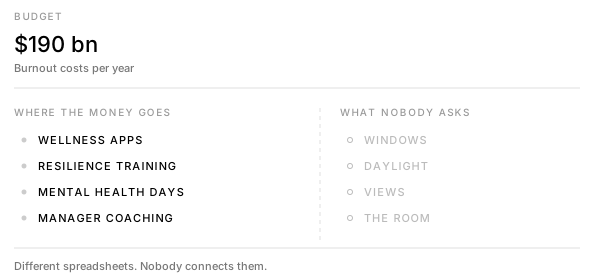
What was also interesting was that entire industries formed around this problem and profited handsomely: wellness apps, resilience training, executive coaching, mental health days. There’s clearly no shortage of creativity when it comes to profitably treating the symptoms.
But nobody talks about the building and the office space inside it where a person sits who is suffering from these symptoms.
My window in Munich had good light. By most standards it was a decent office. But the view created a tension I carried every day. It wasn’t just the view alone, it was also the constellation of how the surrounding buildings were arranged and how my office with its large window was directly exposed to all of it. No HR department was responsible for me, and my tension couldn’t be fixed with any meditation app either. It was constantly there.
This Is Not Just My Experience
A study at the University of Oregon tracked employees in an administrative building. Those with a view of trees and landscape took 16% fewer sick days than those without. The quality of the view was a decisive factor for absenteeism, not the workload and not the management style. It was the view of nature that clearly had a significant influence on health.
At Sherwin-Williams, a redesign with better daylight, improved acoustics and access to nature reduced absenteeism by 44%.
Roger Ulrich’s research on stress recovery and nature views dates to 1991. The data has been there for well over thirty years.
What science tells us receives far too little attention in how buildings are actually built:
Daylight improves sleep, mood and cognitive performance. Employees with windows sleep 46 minutes longer per night.
A view of nature reduces cortisol and speeds stress recovery. Even a plant on a desk measurably reduces anxiety.
Acoustic exposure is the biggest complaint in open offices. Nature sounds accelerate stress recovery by 37% compared to office noise.
Air quality directly affects thinking. Poor ventilation can cut decision-making performance by half.
Spatial control — having somewhere to retreat — correlates with lower emotional exhaustion in every study that measures it.
This is building science. It has been sitting in journals for decades while companies spend billions on apps.
Why Nobody Can See This
When a company wants to address burnout, the HR departments have to get involved. And they think in programs. The building itself is not their department.
By the time anyone asks about the physical environment, the building obviously already exists. The decisions that matter — where the windows are, how high the ceilings are, what you see when you look up — were made years earlier by people who never thought about stress.
Facility management also comes too late. They can add plants and acoustic panels, but they can’t move the windows.
The real decision happens before the architect. The moment the fundamental decision is made that a building should be built. That’s when the question should be asked: what should this building do to the people inside it? Ideally even before the site decision, because that also has a significant influence on how the building and its surroundings affect people.
That’s where the root of the real problem lies.
Two Scenarios
New construction: If you plan for people from the start, the cost difference is minimal. Good orientation costs the same as bad orientation. The view is a planning decision, not a direct cost factor.
The result can be a building that prevents problems at the root. With measurable outcomes like lower turnover, fewer sick days and longer lease durations, returns develop positively too.
Existing buildings: Now you pay twice. Once for the original design, once to fix it. Most companies end up here sooner or later if they planned wrong. And wrong planning is avoidable if you use the right data and have the right planners.
The Math
The average professional services employee generates 572,000 dollars per year. Lost time from stress-related absence and distraction costs about 17,000 dollars per employee. That’s 3% of productive capacity that simply evaporates.
A 200-person office losing 3% burns 3.4 million dollars per year.
The study at the University of Oregon found that a better view alone recovers 11 hours per employee per year. For 200 employees, that’s 605,000 dollars per year.
The Gap
I always have to think about my office with the large window in the middle of Munich. The light was really great and maybe the reason I lasted so long in it. But the view was a serious problem because it showed me every day where I couldn’t be. Like a constant quiet interference that I carried home as a stress factor every evening.
How these texts are written is explained here.